I don't think anyone's going to try arguing that fruit and vegetables are not good for your health! We know they're good. But that's just general "oh, I know it's good for me" — do you know that the benefits are not only for your general health, your protection against obesity and diabetes, cancer and heart disease, but also for your brain. Actually, there's two aspects to this. An unhealthy diet (one rich in junk food, in saturated fat and sugar) is actively bad for your brain, and (the right) healthy diet is actively good for your brain.
Articles
Movement with Meaning: A Multisensory Program for Individuals in Early-Stage Alzheimer's Disease
Those of us in the field of dementia care are reexamining our philosophical beliefs and exploring practical, hands-on approaches in our relationships with individuals living with Alzheimer's disease. We are creating innovative programs and developing a new framework for preserving the emotional health, autonomy, and dignity of those who need us to walk hand in hand with them, witnessing the process of their experiences with empathy and respect.
Find out about the pegword mnemonic
Here are pegwords I've thought up in the Spanish language.
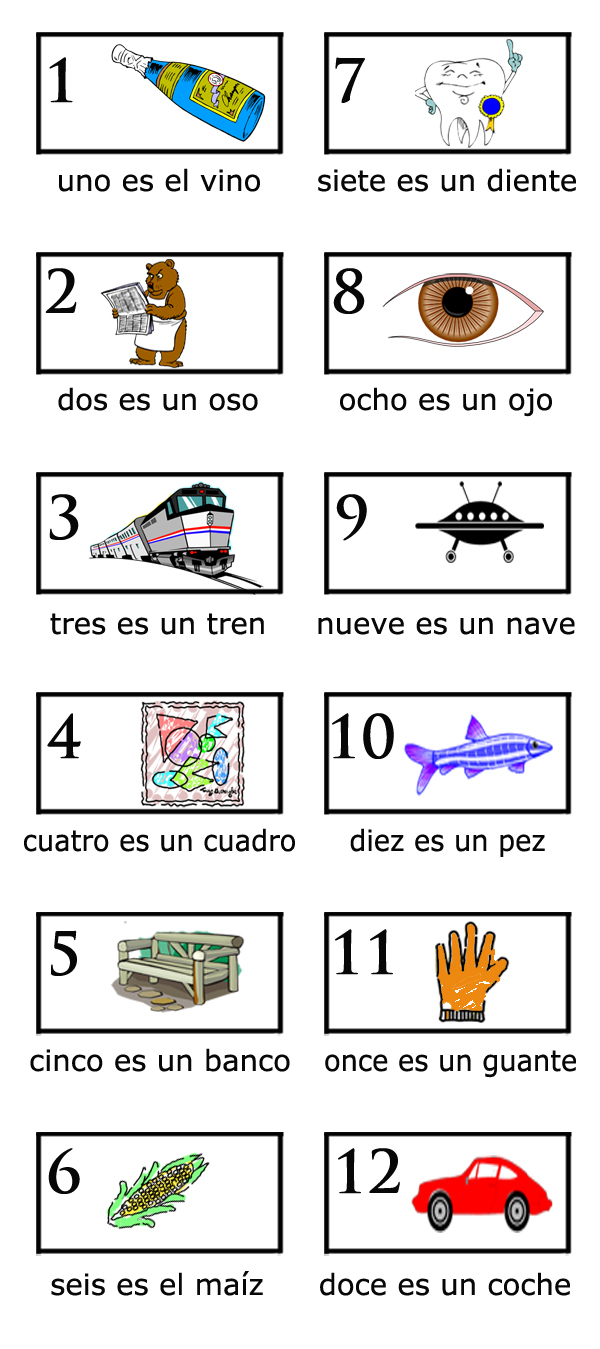
As with the original example, let's try it out with our cranial nerves.
En español, los nervios craneales son:
Transfer refers to the ability to extend (transfer) learning from one situation to another. For example, knowing how to play the piano doesn’t (I assume) help you play the tuba, but presumably is a great help if you decide to take up the harpsichord or organ. Similarly, I’ve found my knowledge of Latin and French a great help in learning Spanish, but no help at all in learning Japanese.
Children’s understanding, and their use of memory and learning strategies, is a considerably more complex situation than most of us realize. To get some feeling for this complexity, let’s start by looking at a specific area of knowledge: mathematics.
Children's math understanding
Here’s a math problem:
Pete has 3 apples. Ann also has some apples. Pete and Ann have 9 apples altogether. How many apples does Ann have?
This seems pretty straightforward, right? How about this one:
I have spoken before, here on the website and in my books, about the importance of setting specific goals and articulating your specific needs. Improving your memory is not a single task, because memory is not a single thing. And as I have discussed when talking about the benefits of ‘brain games’ and ‘brain training’, which are so popular now, there is only a little evidence that we can achieve general across-the-board improvement in our cognitive abilities.
A number of countries have national curricula: France, Hungary, Ireland, Italy, Japan, Korea, the Netherlands, New Zealand, Norway, Portugal, Singapore, Spain, the United Kingdom. Most States in the U.S. follow common guidelines for a core curriculum, although there is no national curriculum as such.
Human memory is a complex and varied phenomenon, and we could delve into its mysteries every day for a hundred years and still have plenty to talk about. But if I had to pick one factor that was absolutely crucial to the operation of memory, I would pick the deceptively simple concept of similarity. Similarity.
We all think we know what that means. An orange is similar to a mandarin; a zebra is similar to a horse; a cup is similar to a glass; my son is similar to his brother. A car is similar to an elephant.
??
Genes
Several genes have been implicated in Alzheimer's, but the big one is the e4 allele of the ApoE gene (on chromosome 19). This variant is found in about a quarter of the population.
Having it doesn't mean you are foreordained to develop Alzheimer's, but it certainly increases the risk substantially. The risk goes up considerably more if both of your genes are the e4 variant (remember you inherit two: one from each parent).