Many people, particularly as they get older, have concerns about short-term memory problems: going to another room to do something and then forgetting why you’re there; deciding to do something, becoming distracted by another task, and then forgetting the original intention; uncertainty about whether you have just performed a routine task; forgetting things you’ve said or done seconds after having said or done them; thinking of something you want to say during a conversation, then forgetting what it was by the time it’s your turn to speak, and so on.
Articles
K. Anders Ericsson, the guru of research into expertise, makes a very convincing case for the absolutely critical importance of what he terms “deliberate practice”, and the minimal role of what is commonly termed “talent”. I have written about this question of talent and also about the principles of expertise. Here I would like to talk briefly about Ericsson’s concept of deliberate practice.
How many words do you need to learn?
An analysis of English vocabulary* has found that the first 1000 words account for 84.3% of the words used in conversation, 82.3% of the words encountered in fiction, 75.6% of the words in newspapers, and 73.5% of the words in academic texts. The second 1000 accounts for about another 5% (specifically, 6% of conversation, 5.1% of fiction, 4.7% of newspapers, 4.6% of academic texts).
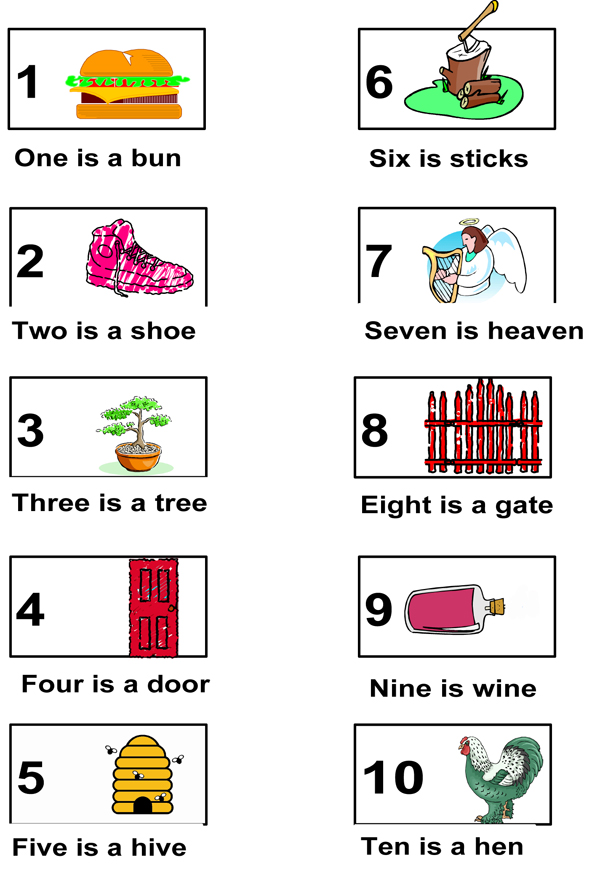
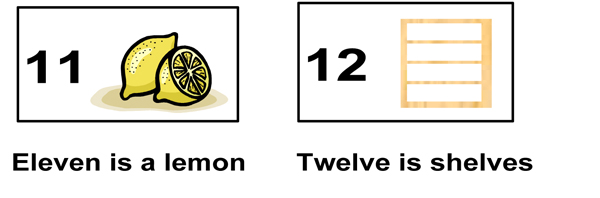
If you have a numbered list to memorize, the best mnemonic strategy is the pegword mnemonic. This mnemonic uses numbers which have been transformed into visual images. Here's the standard 1-10 set.
I add two more:
Genes
Several genes have been implicated in Alzheimer's, but the big one is the e4 allele of the ApoE gene (on chromosome 19). This variant is found in about a quarter of the population.
Having it doesn't mean you are foreordained to develop Alzheimer's, but it certainly increases the risk substantially. The risk goes up considerably more if both of your genes are the e4 variant (remember you inherit two: one from each parent).
A very common situation today, which is probably responsible for a great deal of modern anxiety about failing memory, is that where we're required to “multitask”, that trendy modern word for trying to do more than one thing at a time. It is a situation for which both the normal consequences of aging and low working memory capacity has serious implications.
Michael Gove is reported as saying that ‘Learning facts by rote should be a central part of the school experience’, a philosophy which apparently underpins his shakeup of school exams. Arguing that "memorisation is a necessary precondition of understanding", he believes that exams that require students to memorize quantities of material ‘promote motivation, solidify knowledge, and guarantee standards’.
What is neurogenesis?
Neurogenesis — the creation of new brain cells — occurs of course at a great rate in the very young. For a long time, it was not thought to occur in adult brains — once you were grown, it was thought, all you could do was watch your brain cells die!
Adult neurogenesis (the creation of new brain cells in adult brains) was first discovered in 1965, but only recently has it been accepted as a general phenomenon that occurs in many species, including humans (1998).
A brief round-up of a few of the latest findings reinforcing the fact that academic achievement is not all about academic ability or skills.Most of these relate to the importance of social factors.
Improving social belonging improves GPA, well-being & health, in African-American students