The limitations of working memory have implications for all of us. The challenges that come from having a low working memory capacity are not only relevant for particular individuals, but also for almost all of us at some points of our lives. Because working memory capacity has a natural cycle — in childhood it grows with age; in old age it begins to shrink. So the problems that come with a low working memory capacity, and strategies for dealing with it, are ones that all of us need to be aware of.
Articles
Broadly speaking, a concept map is a graphic display that attempts to show how concepts are connected to each other. A concept map is a diagram in which labeled nodes represent concepts, and lines connecting them show the relationships between concepts.
There is one type of concept map you’re probably all aware of — mind maps. Mind maps are a specialized form of concept map popularized very successfully by Tony Buzan.
A mind map has four essential characteristics:
Let me start by saying that if you're healthy and are eating a good balanced diet, there should be no need for you to take supplements. I also want to emphasize that the best way of meeting your body's needs for certain vitamins and minerals is to get them from food. In some cases, for one reason or another, this may not be possible. For example, as a (mostly) vegan, I take iron and B12 supplements, to make up for these deficiencies in my diet. Elderly adults with small appetites may also find it hard to get all the nutrients they need from their diet.
In my article on using cognates to help you learn vocabulary in another language, I gave the example of trying to learn the German word for important, ‘wichtig’, and how there’s no hook there to help you remember it (which is why so many of us fall back on rote repetition to try to hammer vocabulary into our heads).
Prevalence
Vascular dementia, as its name suggests, is caused by poor blood flow, produced by a single, localized stroke, or series of strokes.
It is the second most common dementia, accounting for perhaps 17% of dementias. It also co-occurs with Alzheimer's in 25-45% of cases. Although there are other types of dementia that also co-occur with Alzheimer's, mixed dementia generally refers to the co-occurrence of Alzheimer's and vascular dementia.
Find out about the pegword mnemonic
Here are pegwords I've thought up in the Italian language.
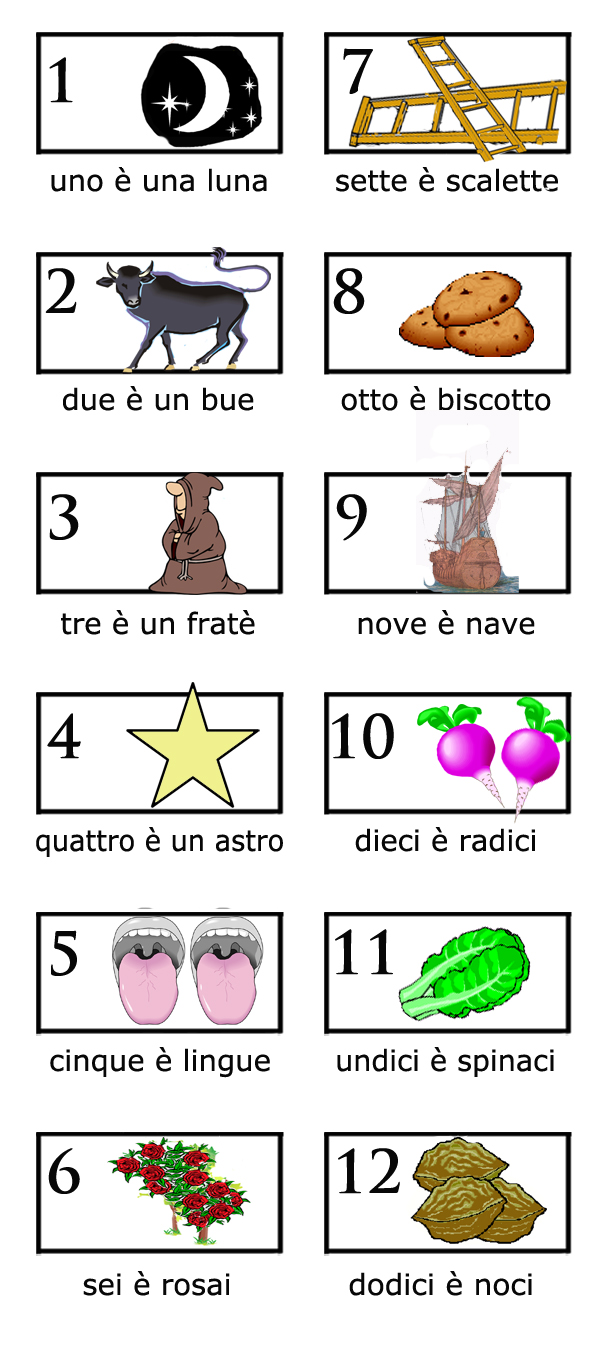
As with the original example, let's try it out with our cranial nerves.
In italiano, sono i nervi cranici:
Short-term vs long-term memory
Working memory is a relatively recent term, a refinement of an older concept - that of short-term memory. Short-term memory was called thus to distinguish it from "long-term memory" - your memory store.
The conventional view of brain development has been that most of this takes place in utero and in the first three years, with the further development continuing until the brain is fully mature at around 10-12 years of age. The turbulence of adolescent behavior has been deemed to be mostly caused by hormonal changes. Piaget, who identified four stages of cognitive development, assessed that his highest stage — that of formal, abstract reasoning — occurred around 13-14 years (although not everyone reaches this level, which requires appropriate education).
"Consolidation" is a term that is bandied about a lot in recent memory research. Here's my take on what it means.
Becoming a memory
Initially, information is thought to be encoded as patterns of neural activity — cells "talking" to each other. Later, the information is coded in more persistent molecular or structural formats (e.g., the formation of new synapses). It has been assumed that once this occurs, the memory is "fixed" — a permanent, unchanging, representation.
What are external memory aids?
External memory aids include such strategies as: